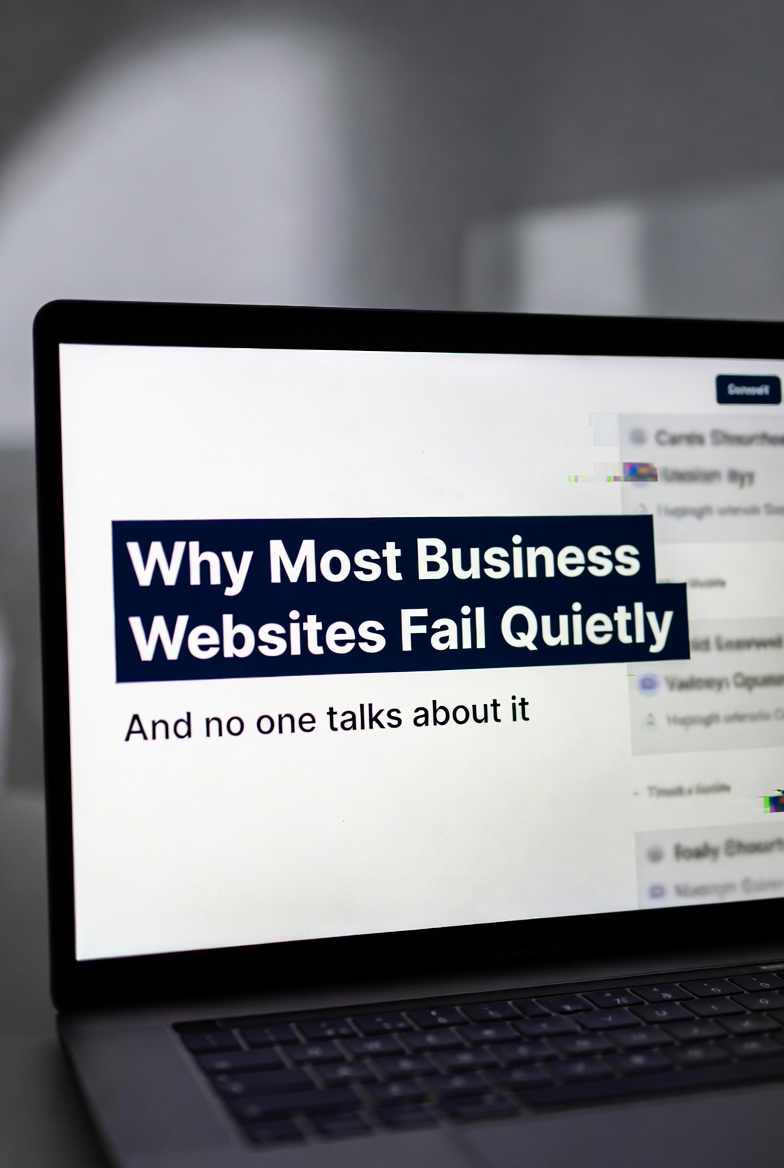

Many websites don’t fail because they’re poorly built — they fail because they were built too soon.
One of the most overlooked causes of business website failure is timing.
Not launch timing — thinking timing.
Most websites are designed and developed before the core questions are clearly answered. When that happens, the site may look complete, but it never fully works.
The “Too Early” Problem
In many projects, the process looks like this:
- pick a platform
- choose a theme
- define pages
- start building
Only later do questions appear:
- Who is this really for?
- What decision should a visitor make here?
- What problem are we solving first?
At that point, the website is already constrained by early decisions.
A website built too early becomes expensive to rethink later.
Business Website Failure Starts Before Design
This is why business website failure often feels confusing.
Nothing is “wrong” — but nothing is aligned either.
When thinking comes after execution:
- messaging stays generic
- pages compete instead of supporting each other
- conversions rely on persuasion instead of clarity
This isn’t a tooling issue.
It’s a sequencing issue.
Clear Thinking First, Structure Second
Strong websites usually follow the opposite order:
- Clarify the business goal
- Define the primary user decision
- Shape content around that decision
- Then choose tools and design
This approach reduces rework, complexity, and long-term friction.
It also explains why simpler sites often outperform more complex ones.
(We touched on this earlier when discussing why clear thinking creates real leverage in web projects.)
Why This Matters Long-Term
Websites built after the thinking is finished:
- adapt faster
- scale more cleanly
- cost less to maintain
More importantly, they stay relevant longer — because the foundation isn’t tied to trends or tools.
UX research consistently shows that users don’t want more features; they want fewer decisions with clearer outcomes.
That’s not a design insight. It’s a thinking one.
Final Thought
A website doesn’t need to be perfect on day one.
But it does need to be intentional.
If the thinking isn’t ready, building faster won’t help — it just locks uncertainty into code.
If your website feels like it’s constantly being adjusted instead of moving forward, the problem may not be execution — it may be that it was built before clarity had time to settle.